

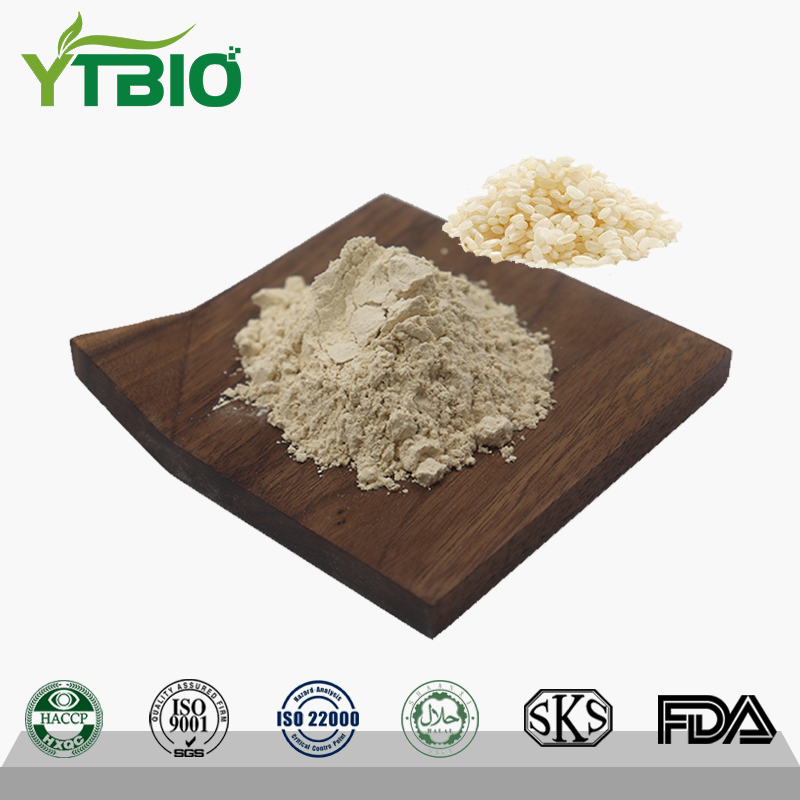
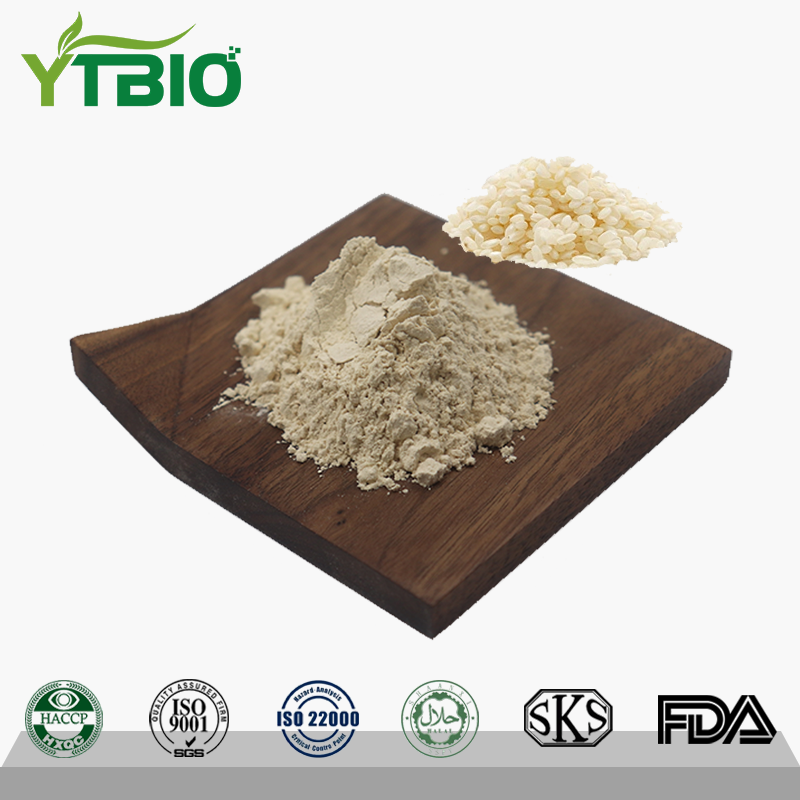
Manufacturer Supply Rice Protein powder
What nutrients do Rice protein contain?
Rice protein (RP) is a plant-based protein extracted from rice and its processing byproducts. Its key characteristics are as follows:
1.Nutritional properties
Balanced amino acid profile
High digestibility
Good bioavailability
2.Safety advantages
Hypoallergenicity (significantly lower than wheat and corn protein)
Good gastrointestinal tolerance
3.Application value
Recognized as a high-quality dietary protein source
Especially suitable for individuals with allergies and special dietary needs
Why Choose YTBIO’s Rice Protein Powder?
We own our factory with over 12 years of experience producing plant-based protein raw materials for sports nutrition, vegan supplements and functional food.
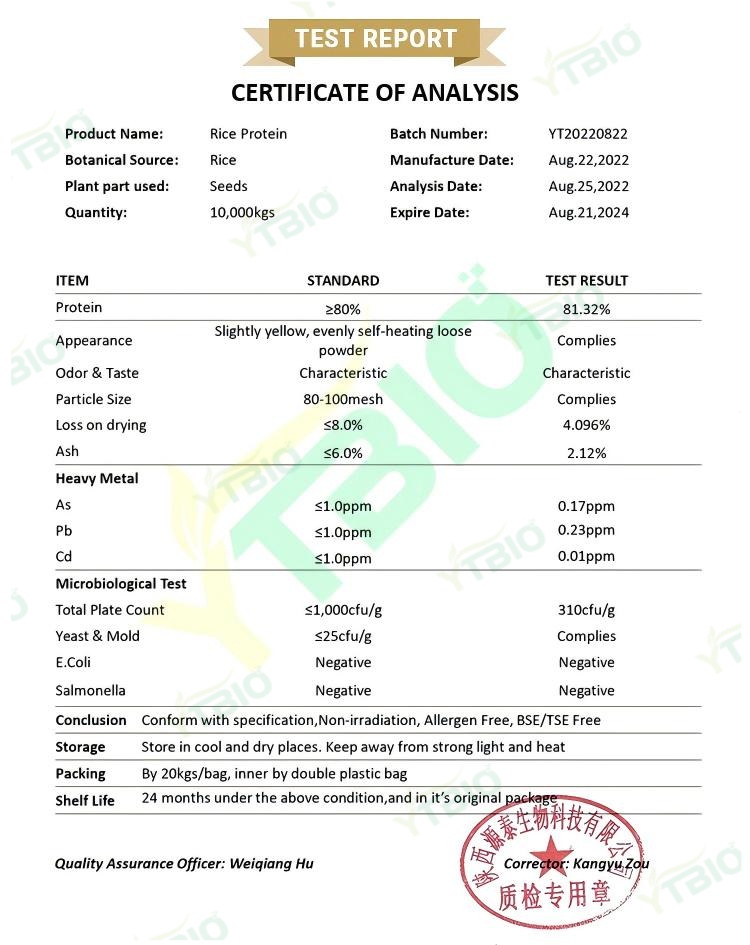
Our production system holds full international certifications: cGMP, FSSC22000, BRC, HACCP, HALAL, KOSHER, ISO9001 & ISO22000, fully compliant with global food safety standards.
Our rice protein powder is made from non-GMO whole rice via low-temperature enzymolysis separation, available in multiple protein content specs: 80% / 85%.
Rice Protein Characteristics
1. Solubility
Rice protein has poor solubility, primarily due to its composition of over 80% alkali-soluble glutenin, which is agglomerated by disulfide cross-linking. Water-soluble albumin accounts for only 2%-5%. Solubility is affected by the following factors:
· pH: Solubility increases slowly between pH 4 and 7, but increases significantly near pH 9.
· Modification: Deamidation can improve solubility (with a deamidation degree of 19.6% to 64.5%, solubility reaches a maximum of 96.6%).
· Enzymatic Hydrolysis:
The maximum solubility achieved by hydrolysis with alkaline protease alone is 43.12%.
The synergistic hydrolysis with alkaline protease and a combination of proteases yields the best results (solubility reaches 71.46%).
The order of enzymatic hydrolysis significantly affects solubility (using the combination of proteases followed by alkaline proteases yields only 54.73% solubility).
2. Emulsification
Emulsification performance includes both emulsifying activity and stability, and improvements in solubility depend on improved solubility:
· The emulsifying capacity of dissolved gluten is comparable to that of soy protein;
· Treatment with Na₂SO₃ can disaggregate subunits, significantly improving emulsification (e.g., RPI and E-RPI modification show significant improvements).
3. Foaming
Alcalase modification can optimize foaming performance, but performance varies under different conditions:
· At neutral pH: Increased protein concentration → increased foaming, but decreased foam stability;
· pH 6.8 (neutral): Optimal foaming and stability;
· Enzyme Type Comparison:
Papain-extracted rice protein exhibits superior overall foaming properties;
Alcalase-extracted foams have poorer stability but exhibit a wide pH adaptability.
Nutritional properties of rice protein
1. Hypoallergenicity
Rice protein has extremely low antigenic activity. Clinical studies have shown that its allergenic risk is significantly lower than that of other plant proteins (such as wheat and corn). This characteristic makes it:
· An ideal protein source for infant formula
· A safe choice for elderly nutritional foods
· An important dietary alternative for people with allergies
2. High Nutritional Value
The amino acid composition of rice protein closely matches human needs:
· With a biological value (BV) of 77%, its digestion and absorption efficiency is superior to that of corn and wheat proteins.
· Its essential amino acid content is well-balanced, meeting the WHO/FAO (1973) recommended standards.
Its lysine content is high (compensates for common deficiencies in cereal proteins).
Over 80% of the alkali-soluble gluten content provides a high-quality protein structure.
Application Advantages: Combining safety with nutritional benefits, it is particularly suitable for dietary supplementation for special populations and the development of functional foods.
Application direction
Rice protein is widely used in the food industry. It can be used as a food additive to produce soy sauce, high-protein powder, protein drinks, peptone and protein foaming powder. In addition, rice protein can be degraded into short peptides or amino acids to make amino acid nutrient solution with extremely high nutritional value, which can be used in health drinks, condiments, etc.
In the feed industry, rice protein powder is a by-product of rice starch. It contains rich feed nutrients, can improve feed utilization, and reduce part of the protein consumed as energy, so as to save feed, improve feed utilization, and reduce feed costs.
FAQ
Q: Are you a formal manufacturer and what certifications do you have?
A: 12+ years GMP factory with full global certifications. OEM & ODM customization available.
Q: What specifications of Rice Protein Powder can you supply?
A: 80% plant-based rice protein powder, non-GMO raw material. COA and third-party test supported.
Q: What are the prominent advantages of your Rice Protein Powder?
A: Low-allergy vegan protein, lactose-free, gentle digestion, perfect for sensitive groups and plant-based formulas.
Q: What fields can this product be used in and how to store it properly?
A: Vegan protein supplements, meal replacement powder and functional drinks. 24 months shelf life, store cool, dry and dark sealed environment.
Q: What’s your MOQ production lead time?
A: 25kg standard MOQ. 7-15 working days lead time.
Q: What after-sales support can you provide for buyers?
A: Formulation technical guidance.
Email: sales@sxytbio.com
WhatsApp/phone: +86 17782577059