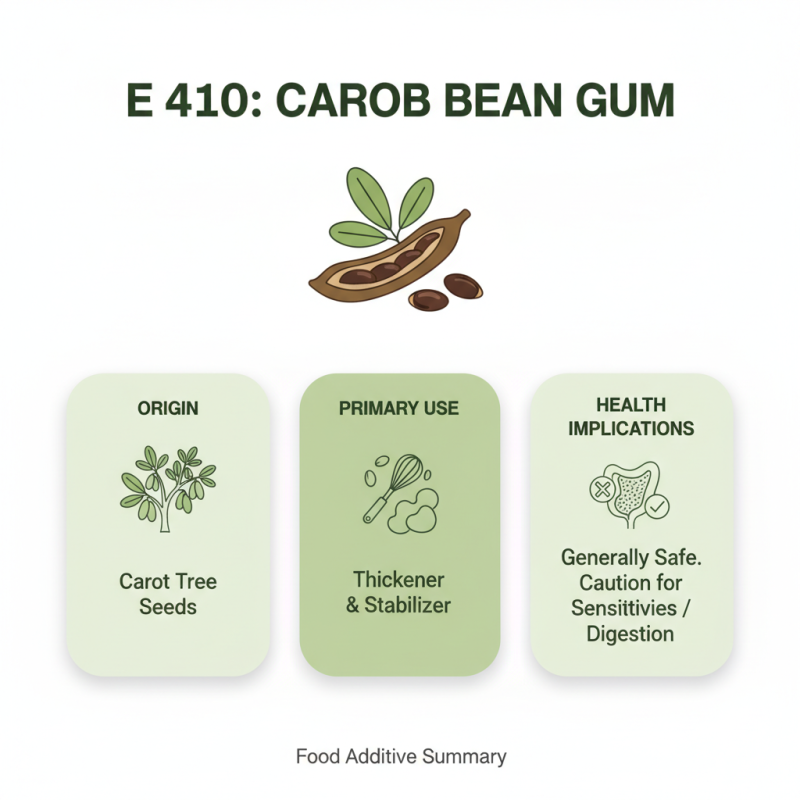
The E 410 food additive, commonly known as carob gum, plays a crucial role in the food industry as a thickening agent and stabilizer. According to a recent market analysis by Food Ingredients International, the global demand for food additives is projected to reach $200 billion by 2025, with E 410 taking a significant share due to its multifunctionality and natural origin. Food scientists have hailed its efficacy in both enhancing texture and preserving flavor, making it a preferred option among manufacturers looking to meet consumer demands for clean-label products.
Dr. Emily Carter, a leading expert in food technology and author of the influential report "Innovations in Food Additives," emphasizes the importance of E 410: "As we move towards more natural formulations, E 410 offers an effective way to improve product quality without compromising safety or consumer preference." This sentiment is echoed by numerous industry analyses that indicate a shift towards naturally derived additives, with E 410 at the forefront due to its unique properties and versatility.
In light of increasing health consciousness among consumers and a growing trend for clean label ingredients, understanding the facts about E 410 food additive has never been more critical. This article will delve into the top ten essential facts that highlight the significance of E 410, its applications, and its impact on modern food production.

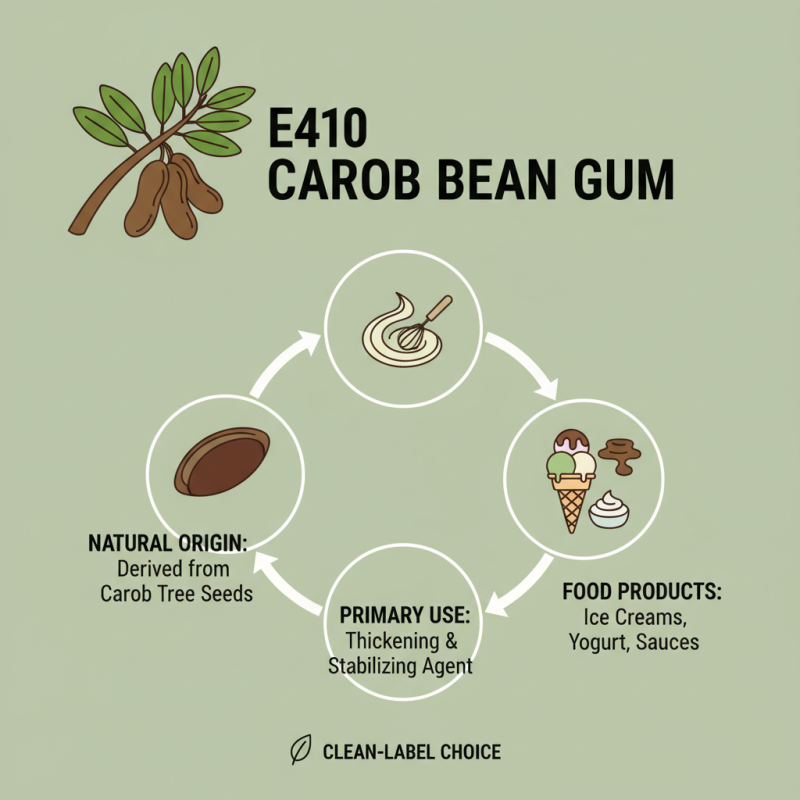
E 410, commonly known as carob bean gum, is a natural food additive derived from the seeds of the carob tree. It is primarily used as a thickening and stabilizing agent in various food products. E 410 is particularly valued for its ability to improve texture and viscosity in items such as ice creams, yogurt, and sauces. Thanks to its natural origins, it has become a popular choice among manufacturers aiming to provide clean-label products without synthetic additives.
In terms of standard uses, E 410 plays a crucial role in the food industry. It helps to enhance the mouthfeel of creamy products and acts as a gelling agent in desserts and confections. Additionally, it can prevent the separation of ingredients in products like dressings and mayonnaise, thereby maintaining a uniform consistency. E 410 is also employed in gluten-free products as a substitute for the elasticity typically provided by gluten, making it an essential ingredient for those with dietary restrictions. Its versatility and functional properties have made it a staple in modern food processing.
E 410, also known as carob bean gum, is a food additive derived from the seeds of the carob tree, native to the Mediterranean region. The extraction process involves a series of steps that begin with harvesting the pods of the carob tree. Once collected, the pods are dried and the seeds are separated from the pulp. These seeds are then ground into a powder, which is subsequently processed to isolate the gum. This natural thickening agent possesses unique gel-forming properties, making it valuable in various food applications.
The production methods for E 410 vary, but they typically adhere to the principles of food safety and quality control. Initially, the seeds undergo cleaning and sorting to ensure only the highest quality materials are used. The gum is then extracted through a process that may involve mechanical or chemical methods, with an emphasis on retaining its functional properties.
Following extraction, the carob bean gum is dried and milled to achieve a consistent particle size, facilitating its incorporation into food products. As a result, E 410 is widely utilized in the food industry, serving as a stabilizer, thickener, and emulsifier in a range of products, from dairy items to confectionery goods.
E 410, also known as carob bean gum, is a food additive derived from the seeds of the carob tree. It is primarily used as a thickening and stabilizing agent in various food products. Health implications concerning E 410 mainly revolve around its digestibility and potential allergic reactions. Generally recognized as safe by regulatory authorities, this additive is deemed acceptable for consumption in moderate amounts. However, individuals with specific sensitivities or gastrointestinal issues may experience discomfort when consuming foods containing E 410.
Safety assessments of E 410 have been conducted by various health organizations. These evaluations consider factors such as the additive's effects on human health, potential toxicological concerns, and its impact on gut health. Studies have demonstrated that E 410 is not linked to significant adverse effects when consumed within regulated limits. Furthermore, it is important to understand that while carob bean gum can contribute to a healthy diet as a source of dietary fiber, excessive intake may lead to gastrointestinal disturbances, highlighting the importance of moderation in consumption.
E 410, commonly known as carob bean gum, plays a significant role in the food industry as a thickening and stabilizing agent. Derived from the seeds of the carob tree, this naturally occurring polysaccharide is widely used in various food applications due to its ability to enhance texture and improve mouthfeel. According to a recent market analysis by Research and Markets, the global food emulsifiers market, which includes E 410, is projected to reach USD 4.6 billion by 2025, indicating a growing demand for such additives in food formulations.
In product formulations, E 410 is particularly valuable in gluten-free products, dairy alternatives, and sauces. It exhibits excellent thickening properties and can effectively prevent separation in emulsified products, making it ideal for salad dressings, spreads, and dairy substitutes. A study published in the Journal of Food Science found that the inclusion of E 410 in dairy-free ice creams improves texture stability and consumer acceptability. Furthermore, its multifunctionality—acting as a thickener, stabilizer, and gelling agent—highlights its importance in meeting the modern consumer's demand for texture and quality in food products.
The regulatory status of E 410, also known as carob bean gum or locust bean gum, is crucial for its safe use in various food products. Classified as a food additive in the European Union, E 410 is subject to strict safety assessments and must meet specific standards set by regulatory bodies such as the European Food Safety Authority (EFSA). These assessments evaluate its potential impact on human health, ensuring that it can be used safely within established limits. The additive is permitted in a wide range of food categories, particularly as a thickening and gelling agent, which enhances the texture and stability of products.
Labeling requirements for E 410 are also well-defined to ensure transparency for consumers. Food manufacturers are obligated to list E 410 explicitly on product ingredient labels. In the EU, additives must be identified by their E number or name, allowing consumers to make informed choices. This labeling process is vital, especially for individuals with dietary restrictions or allergies. Additionally, the continuous monitoring of E 410's usage in food products helps ensure compliance with safety standards and reinforces consumer trust in the food supply chain.
| Fact Number | Fact Description | Regulatory Status | Labeling Requirements |
|---|---|---|---|
| 1 | E 410 is derived from the seed of the carob tree. | Approved for use in the EU and many other regions. | Must be listed on the ingredient label as "E 410." |
| 2 | Commonly used as a thickener, gelling agent, and stabilizer. | Regulated in food products, with specific usage levels. | Label must indicate the function of the additive. |
| 3 | E 410 is often found in dairy products, sauces, and dressings. | Permitted under certain conditions for other products. | Must not mislead consumers about the nature of the food. |
| 4 | Considered safe for human consumption within approved limits. | Review and monitoring by food safety authorities. | No specific warnings are necessary on labels. |
| 5 | It can be used in gluten-free products. | EU legislation allows its use in gluten-free food. | Must be declared when used in gluten-free labelling. |
| 6 | E 410 functions well in high-fat products. | Restrictions apply to the quantity in certain applications. | No need for additional labeling if within limits. |
| 7 | Can be found in both organic and non-organic products. | Allowed in food labeled as organic in some jurisdictions. | Organic labeling must comply with specific guidelines. |
| 8 | It is a vegan-friendly food additive. | No animal-derived ingredients involved. | No special labeling required for vegan products. |
| 9 | E 410 has been studied for its health effects. | Reviewed regularly by health organizations. | Generally regarded as safe; individual sensitivities may vary. |
| 10 | Usage is widespread in the food industry. | Constantly monitored by food safety regulations. | Usage must comply with prevalent food laws. |