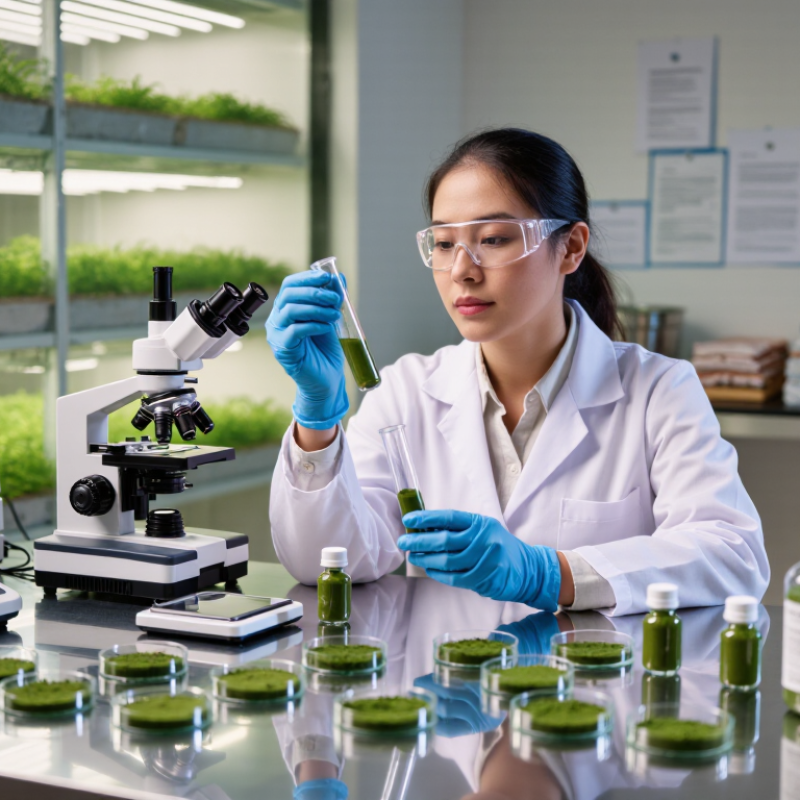
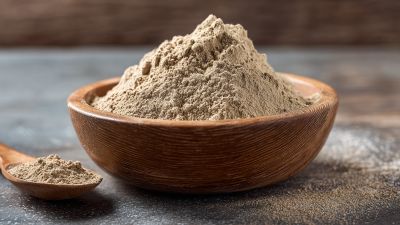
China Best Chlorella CGF Supplier for Global Buyers? This question deserves evidence, not polished promises. Chlorella Cgf is a specialized ingredient requiring controlled cultivation, careful cell-wall processing, and batch-level testing. Global buyers should examine more than product color or brochure claims. They need origin records, extraction specifications, microbiological results, heavy-metal analysis, and stable supply documentation.
Grand View Research estimates the global chlorella market will expand at approximately 6.7% annually through 2030. However, most commercial reports group CGF within the broader chlorella category. That limitation matters. It makes supplier comparisons less precise. The FAO’s 2024 fisheries and aquaculture report also highlights algae’s growing role in sustainable food and ingredient systems, although it does not separately measure Chlorella Cgf. Therefore, buyers should request product-specific evidence instead of relying on market size alone.
Robert Henrikson, a longtime chlorella author and industry educator, wrote, “Chlorella is a food, not a drug.” That distinction remains practical for international procurement. A responsible Chinese supplier should provide HACCP or ISO 22000 systems, transparent country-of-origin records, third-party certificates, and clearly defined CGF specifications. Ask for recent certificates of analysis. Check whether results match the shipped batch. Inspect the powder’s texture, odor, packaging seal, and lot number. Small details reveal operational discipline. Not every supplier publishes enough information. That is a weakness worth acknowledging, not hiding. For global buyers, the strongest partnership combines manufacturing experience, scientific documentation, regulatory awareness, and honest limits around available data.
Chlorella CGF usually refers to a water-soluble fraction extracted from chlorella biomass. It is not simply whole chlorella powder. Processing conditions can change its color, solubility, odor, and nutrient profile. Buyers should ask how the extract is produced and which compounds are measured. Clear technical answers matter more than attractive product claims.
Supplier quality affects every batch. Reliable manufacturers control cultivation water, harvesting time, drying temperature, and storage humidity. A professional supplier should provide a complete certificate of analysis for each lot. Test results should cover identity, microbial limits, heavy metals, pesticides, moisture, and key nutritional markers. Traceability should reach the cultivation tank or production date. Small details matter.
Not just paperwork.
A sample may dissolve quickly in warm water but perform differently after transport. Packaging should protect the powder from light, oxygen, and moisture. Buyers can compare retain samples, production records, and independent laboratory results. Yet a certificate alone is not enough. I have seen specifications look precise while testing methods remained unclear. That weakness deserves attention. Experienced suppliers explain limitations instead of promising identical results forever. They also respond when a batch changes slightly, investigate the cause, and document corrective action. For global buyers, communication, consistency, and transparent quality systems are stronger signs of supplier competence than the lowest quotation.
A reliable Chlorella CGF supplier should provide more than a polished product page. Buyers need clear cultivation records, batch identification, and traceability from algae pond to finished powder. Reliable documentation shows where the chlorella was grown, how it was harvested, and when it was processed. This detail matters when supply chains cross several countries.
Laboratory control is equally important. Each batch should include a current certificate of analysis with protein, moisture, microbial limits, heavy metals, pesticides, and relevant contaminants. Independent testing adds credibility, especially when laboratory methods and detection limits are disclosed. The supplier should also explain how CGF is measured, because extraction methods and testing definitions may differ. Vague “high purity” claims are not enough.
Production standards reveal practical experience. Look for controlled cultivation, validated cell-wall processing, hygienic facilities, and documented storage conditions. A dependable supplier can answer technical questions without avoiding inconvenient details. They should provide samples, specification sheets, stability data, and realistic lead times. Communication matters too.
Fast replies help.
Still, no supplier is flawless. Testing can miss a problem, and documents can become outdated. Buyers should verify recent reports, inspect packaging, and compare several batches before committing. A transparent supplier welcomes that scrutiny, even when it slows the first order.
China Best Chlorella CGF Supplier for Global Buyers?
How to Evaluate Chlorella CGF Quality, Safety, and Certifications
Reliable Chlorella CGF evaluation starts with product identity. Ask for the scientific name, cultivation method, extraction process, and storage conditions. The powder should have consistent color, odor, moisture, and particle size. A recent certificate of analysis should match the exact batch number on the carton. Small details matter.
Safety testing needs independent evidence. Review results for heavy metals, microbial limits, pesticides, and common allergens. Testing should come from a laboratory with ISO/IEC 17025 accreditation. Check sample dates, test methods, detection limits, and authorized signatures. Do not accept vague statements such as “food grade” without supporting records. Request a retained sample when possible. It can reveal changes after transport.
Certifications deserve careful attention. HACCP, GMP, and ISO 22000 may support process control, but their scope and validity must be verified. A certificate can look impressive while covering another facility or product category. I have seen buyers focus heavily on documents and overlook factory hygiene, water quality, and lot traceability. That is a weakness worth correcting. Ask for audit reports, corrective-action records, and production photographs with visible lot labels. Even then, one audit cannot predict every future batch. Regular testing and clear communication remain necessary.
| Evaluation Dimension | Recommended Buyer Requirement | Evidence to Request | Why It Matters |
|---|---|---|---|
| Product identity | The specification should clearly identify the material as a Chlorella-derived CGF extract or fraction, including the scientific name of the source organism and the manufacturing process. | Technical data sheet, product specification, process flow chart, and representative sample. | “CGF” is not a universally harmonized international product definition; buyers need a documented identity and process description. |
| Appearance and odor | Uniform powder or liquid form, characteristic algae odor, and no visible foreign matter, mold, or abnormal discoloration. | Batch-specific certificate of analysis (CoA), retained sample, and incoming inspection procedure. | Sensory changes may indicate oxidation, contamination, poor drying, or unsuitable storage. |
| Moisture and water activity | Set a moisture limit appropriate to the dosage form; a common commercial specification for dried powders is ≤ 8% moisture, with water activity commonly controlled below 0.60 where shelf stability requires it. | Validated moisture method, water-activity result, packaging specification, and stability data. | Lower available water helps reduce microbial growth and caking risk, but the final limit must be validated for the product. |
| Protein and nutritional profile | Declare protein, carbohydrate, fat, ash, and relevant nutrients using a consistent analytical basis, such as “as-is” or “dry basis.” Do not accept a generic Chlorella nutrition profile as proof of CGF composition. | Batch CoA, analytical methods, nutrition panel, and independent laboratory verification. | Nutrient levels vary with strain, cultivation conditions, extraction, concentration, and drying. |
| CGF marker or active fraction | Require a defined marker, assay, or fingerprint that is specific to the supplier’s CGF specification. Avoid accepting an unsupported “CGF percentage” without a validated test method. | Method validation, reference standard or calibration details, chromatographic or spectroscopic profile, and inter-batch trend data. | There is no single globally accepted CGF assay or universal minimum CGF content for all products. |
| Microbiological safety | Use destination-market requirements and the intended-use category to set limits for total aerobic count, yeast and mold, coliforms, Escherichia coli, Salmonella, and Staphylococcus aureus. Salmonella and E. coli should be absent where required by the applicable food specification. | Recent CoA, sampling plan, test methods, laboratory accreditation, and environmental monitoring records. | Microbiological limits differ by country, product category, and whether the ingredient is consumed directly or used in further processing. |
| Heavy metals | Test lead, cadmium, mercury, and arsenic using an appropriate instrumental method. Acceptance limits must comply with the importing country, food category, and customer specification. | ICP-MS or equivalent laboratory report, sampling details, site-water controls, and contaminant risk assessment. | Algae can accumulate elements from cultivation water and raw materials; legal limits are jurisdiction-specific. |
| Microcystins and algal toxins | Require a documented risk-based testing program for microcystins and other relevant algal toxins, especially when cultivation water may be exposed to cyanobacteria. | Validated LC-MS/MS or equivalent results, water-monitoring records, and corrective-action procedure. | Chlorella products must be differentiated from contamination by toxin-producing cyanobacteria. |
| Pesticides and environmental contaminants | Screen according to the destination market and risk profile for pesticide residues, dioxins, PCBs, PAHs, and other contaminants where applicable. | Multi-residue laboratory report, cultivation-water assessment, supplier approval records, and annual monitoring plan. | Contaminant requirements depend on the market, source materials, processing steps, and intended application. |
| Allergen and cross-contact control | Provide an allergen statement covering the site, shared equipment, processing aids, and packaging materials. The statement must follow the importing country’s allergen-labeling rules. | Allergen matrix, cleaning validation, production zoning plan, and supplier declarations. | Chlorella itself may not be a regulated major allergen in every market, but cross-contact can occur in shared facilities. |
| Food-safety certification | Prefer a valid, independently audited food-safety system such as HACCP, ISO 22000, FSSC 22000, BRCGS, or an equivalent scheme accepted by the buyer’s market. | Current certificate, scope of certification, issuing body, audit status, and certificate verification record. | A certificate is meaningful only when its scope covers the relevant manufacturing site and product activity. |
| Laboratory competence | Critical safety tests should be performed by an internal or external laboratory competent for the method; ISO/IEC 17025 accreditation is a strong qualification indicator. | Accreditation scope, method number, detection limit, uncertainty information, and sample chain of custody. | The laboratory’s scope must cover the actual analyte and method, not merely hold a general accreditation. |
| Traceability and batch control | Each shipment should have a unique lot number linked to cultivation records, raw materials, processing dates, packaging, test results, and release approval. | One-step-back/one-step-forward traceability test, batch record, recall procedure, and lot-level CoA. | Traceability supports targeted recalls, authenticity checks, and investigation of out-of-specification results. |
| Stability and shelf life | Shelf life should be supported by real-time or accelerated stability data covering moisture, color, odor, microbiology, oxidation where relevant, and the declared CGF marker. | Stability protocol, time-point results, storage conditions, packaging configuration, and expiry-date rationale. | Algal ingredients can be sensitive to oxygen, light, heat, and humidity. |
| Packaging and storage | Use food-contact-compliant packaging with an effective moisture and oxygen barrier; define storage conditions, commonly cool, dry, and protected from direct light. | Packaging specification, food-contact declaration, seal-integrity checks, palletization standard, and transport conditions. | Correct packaging helps preserve color, odor, assay value, and microbiological quality during international transport. |
| Regulatory and labeling readiness | Confirm legal status, permitted use, claims, dosage, and labeling requirements in the destination market before purchase or launch. | Regulatory dossier, ingredient statement, non-GMO or organic documents where claimed, and market-specific compliance declaration. | An ingredient accepted for one country or application may require additional review in another. |
| Supplier performance | Assess on-time delivery, complaint rate, corrective-action response, lot-to-lot consistency, minimum order quantity, and change-notification practices. | Quality agreement, historical CoAs, customer-audit results, complaint log summary, and written change-control procedure. | A technically compliant sample is not sufficient if commercial batches are inconsistent or poorly controlled. |

Buyer note: Numerical limits for microbiology, heavy metals, contaminants, labeling, and permitted use should always be confirmed against the laws and official guidance of the destination market and the product’s intended application.
Choosing the best chlorella CGF supplier in China requires more than comparing prices. Global buyers should inspect the manufacturing process, raw material control, and export experience. Ask how chlorella is cultivated, harvested, dried, and tested. Production areas should show clear hygiene procedures and controlled processing records.
Request recent batch reports for CGF content, microbiological safety, heavy metals, moisture, and contaminants. Confirm whether testing is performed internally or by an independent laboratory. A reliable supplier should provide traceability from cultivation tanks to finished cartons. Check GMP, HACCP, ISO, and other certificates carefully. Certificates must match the factory and remain valid. Small details matter.
Tips: Order samples from different batches. Check color, odor, solubility, packaging, and delivery consistency. Review the technical data sheet before signing. Export capability also includes strong moisture barriers, accurate labels, customs documents, and stable shipping schedules. Ask about minimum order quantities and backup production plans. A polished factory can still miss a minor document detail. I have found that honest communication about delays is often more valuable than confident promises. Suppliers should explain corrective actions when results fail specifications. This may sound less impressive, but it reveals practical quality management. Ensure the final agreement defines specifications, inspection methods, packaging standards, and responsibility for transport damage.
Global buyers can use these representative published composition ranges as a preliminary benchmark when reviewing a supplier’s certificate of analysis. Actual values vary with species, cultivation conditions, harvesting method, and drying process, so exporters should provide batch-specific laboratory results, traceability records, contaminant testing, and documentation suitable for the destination market.
Reference: Becker, W. (2007), “Microalgae in Human and Animal Nutrition,” Handbook of Microalgal Culture. Values shown are approximate midpoints of commonly reported dry-biomass ranges.
Selecting the best Chlorella CGF supplier requires more than comparing prices. FAO’s State of World Fisheries and Aquaculture 2024 reported about 36 million tonnes of aquatic algae production in 2022. However, most volume came from seaweed, not Chlorella. Buyers should request the exact strain, cultivation method, harvest location, and CGF extraction process. A supplier should explain whether CGF means a measured nucleotide-rich fraction or only a marketing term.
Test the evidence. Ask for recent, batch-specific certificates of analysis, not one permanent file. Useful checks include protein content, nucleotides, moisture, microbial limits, heavy metals, pesticides, and algae toxins. AOAC or equivalent validated methods improve credibility. ISO 22000 or HACCP-based controls also matter, but certification alone proves little about product performance. Review at least three consecutive batches. Look for stable results.
Traceability must reach the culture vessel, processing date, packaging lot, and storage temperature. Packaging should protect the powder from moisture and light. In practice, a polished document can still hide weak sampling. That deserves scrutiny. I would also compare the supplier’s retention samples with independent laboratory results. Small differences may reflect testing variation, yet unexplained swings should stop the purchase. Reliable suppliers disclose deviations, corrective actions, shelf-life data, and transport conditions before contract signing.
– Sources: FAO, The State of World Fisheries and Aquaculture 2024; AOAC International analytical guidance.